Blog Campaign stalls
Campaign stalls
Where Marketing Campaigns Get Stuck
We traced 7 of our own campaigns from first draft to result. Our outbound email got 0 replies and our blog got 0 leads, and the stall happened inside our own team.
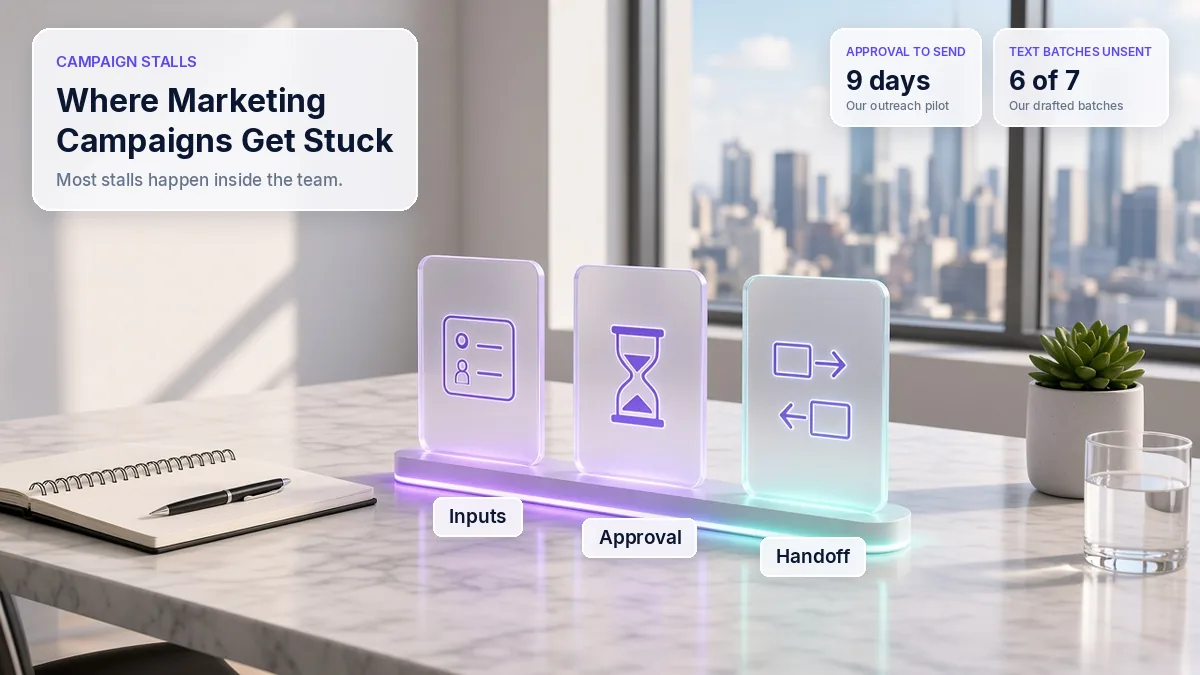
We looked at 7 recent Teamulate campaigns across email, text messages, the blog and social posts, and compared them with a modeled 5-person B2B service firm built from published benchmarks. Our results were plain: 0 replies to account based outreach and 0 leads from the blog. Most stalls happened inside the team: inputs ran out, approvals queued, and handoffs between tools broke. Teamulate figures are our own, and the comparison firm is a modeled example.
0 replies
to 260 account based outreach emails sent to 96 companies, even though 22 of those companies clicked
9 days
between approving an outreach plan and sending its first email
1
prepared text message batch was sent; at least 9 others never went out
The thesis
In our campaigns, most stalls were not in front of the buyer. They sat inside the team, at the points where one person, tool or approval hands work to the next.
Section 1
The stall happens inside the team
Our own numbers first.
We run Teamulate on the same kind of small, stretched marketing setup many of our readers have. So before writing about where campaigns get stuck, we traced our own. Teamulate figures are our own, and the comparison firm is a modeled example.
Teamulate campaigns, real results
| Campaign | What went out | Result | Where it stalled |
|---|---|---|---|
| Account based email outreach | 260 emails to 96 companies | 22 companies clicked, 0 replies, 0 meetings | Contact lookup credits ran out; a tracking link bug |
| Scored outreach pilot | 12 first emails | 0 replies, 1 bounce on day 1 | 9 days from approval to send |
| Text messages with demo pages | 15 shops texted | No replies recorded | Only 1 prepared batch sent; at least 9 others never went out |
All three rows are real Teamulate campaigns.
The click numbers say people were curious. 22 of 96 companies clicked, a 22.9% company click rate. But clicks turned into 0 replies and 0 meetings. When we followed each campaign step by step, most of the lost time sat between our own steps, not in the buyer's inbox.
Section 2
Inputs run out
A campaign cannot send what it does not have.
Our account based outreach relied on a free tier of an email lookup tool. When the free credits ran out, first touch emails went on hold from 14 September for about two weeks. Nothing was wrong with the copy. There was simply no one new to send to.
- Know which free tier or quota each campaign depends on, and when it resets.
- Build the list before the send window opens, not during it.
- Have a manual fallback for any lookup step that can be blocked.
Section 3
Approval queues
Work that is done but not sent is still waiting.
Our scored outreach plan was approved on 6 October. The first emails went out on 15 October, 9 days later. Each batch needed its own yes, and every yes waited for a free moment in someone's day.
Our text message campaign shows the same pattern at a larger scale. We prepared batches of personalized messages with demo pages. Only 1 batch was ever sent, to 15 shops. At least 9 others stayed unsent.
In our modeled example firm, content follows the same path: writer, reviewer, approver, publish. Its posts wait about 9 days for sign off. That 9 days is an assumed figure for the made up firm, not a measurement, and it is separate from our own real 9 day lag above.
- Approve the plan and the rules once, then approve batches inside those rules quickly.
- Set a time limit for each approval step.
- Count drafted but unsent work as a stalled campaign, not a finished one.
Section 4
Broken tool handoffs
Every tool change is a place to lose data.
One follow up email in our outreach went out with a placeholder left in the tracking link. That bug made 13 website sessions impossible to attribute to the right company.
Our video and social posts are scheduled in one tool and recorded in a separate ledger. Post links were never copied back, so 8 of 12 topic rows in that ledger are incomplete. We also posted 1 accidental duplicate on X.
In the modeled example firm, ad leads leave the ad platform through a weekly CSV export, so a new lead can wait days before sales sees it. Webinar attendees are uploaded to the CRM by hand, and follow up goes out 72 hours later. Again, these are modeled figures.
- List every handoff in a campaign and name who checks it.
- Test tracking links before the send, not after.
- Replace weekly exports with a direct connection where you can.
Section 5
Response speed
A modeled example, with cited benchmarks.
Our own campaigns produced no leads to respond to, so this section uses a modeled example: a made up 5-person B2B service firm over one quarter. Its volumes are our assumptions. Its rates come from the published benchmarks named under each row and in the sources.
Modeled example (not Teamulate data): a 5-person B2B service firm, one quarter
| Campaign | Volume | Result | Time to follow up | Where it stalls |
|---|---|---|---|---|
| Cold email | 2,000 delivered | 10 replies (0.5%), 3 meetings | 30 hours on average | 4 of 10 replies never logged to the CRM |
| LinkedIn ads | 95,000 impressions, 640 clicks (0.67%) | 30 leads | About 2 days (our assumption) | Weekly CSV export delays the sales handoff |
| Facebook and Instagram ads | 130,000 impressions, 1,020 clicks (0.79%) | 14 leads | 52 hours | Low intent leads rejected by sales |
| Content and SEO | 6 posts, 1,800 sessions | 18 leads (1%) | 24 hours | Posts wait about 9 days for approval (assumed) |
| Webinar | 1,500 invites, 120 registrants | 45 attendees, 6 sales qualified leads | 3 days | Attendee list uploaded by hand |
Modeled example. Volumes and follow up times are our assumptions. Rates from Belkins and QuickMail (cold email replies), Metadata (ad click rates) and LeanData (organic form conversion).
Published research points the same way on speed. InsideSales found conversion rates were 8x higher when a rep tried to make contact within 5 minutes than when they waited 6 minutes or more. In the modeled firm, no channel follows up within an hour, let alone 5 minutes.
For context on replies, Belkins measured a 0.45% average reply rate across 7.5 million cold emails sent in 2025, and QuickMail reports a median of 0.48%. Mailshake's 2025 report, based on a survey of 508 outbound professionals, puts the average reply rate at 1 to 4%. That figure is self reported, not measured campaign data.
Section 6
Reach without results
Traffic is not the same as leads.
Across our whole website, analytics recorded 57 sessions in one week (28 September to 4 October), and 6 of them came from organic search. Over 28 days the site had 259 sessions, 10 of them organic. The blog recorded 0 leads.
These are site level figures, read from our analytics dashboard on 5 October. The blog posts themselves were only tagged on 6 October, so blog visits before then were not counted on their own. That is a measurement gap in itself. The rest is distribution: an organic share of 10.5% in one week and 3.9% over 28 days means most visitors came from links we shared, not from search.
For comparison, LeanData's 2022 benchmark puts the median organic form conversion at 2%, though the report notes only 26% of the companies it surveyed measure this, so the sample is small. Our modeled firm reaches 1%. We are still at 0.
Section 7
An unsticking checklist
Run this before the next campaign goes out.
- Inputs: Is the contact list built and checked, and is every quota or credit topped up for the full send window?
- Approvals: Is the plan approved once, with a time limit on each batch approval?
- Drafts: Is anything drafted but unsent? Send it, or delete it on purpose.
- Tracking: Has every link been clicked and checked in analytics before sending?
- Handoffs: Does every lead move from form or inbox into the CRM without a manual export?
- Speed: Who answers a new reply, and can they do it within 1 hour?
- Records: Is every published post written back to one ledger the same day?
- Results: Are you counting replies and leads, not just clicks and sessions?
Key terms and facts
The short version
- Stall point
- The step where a campaign stops moving, such as an empty contact list, a pending approval or a broken link between tools.
- Handoff
- Any point where work passes from one person or tool to another, for example from an ad form into a CRM.
- Response time
- How long a new reply or lead waits before someone follows up.
- Modeled example
- A made up firm whose volumes are our assumptions and whose rates come from published benchmarks. It is not real data.
Key facts
- TEAMULATE OUTREACH260 emails to 96 companies, 22 companies clicked (22.9%), 0 replies, 0 meetings.
- TEAMULATE APPROVALS9 days from plan approval to first send; only 1 prepared text batch sent; at least 9 others never went out.
- TEAMULATE SITE57 sessions in 7 days across the whole site, 6 organic, 0 blog leads recorded.
- BENCHMARKmeasured cold email reply rates sit near 0.45% to 0.48% (Belkins, QuickMail).
- BENCHMARKInsideSales found conversion 8x higher when a rep tried to reach a lead within 5 minutes rather than 6 minutes or more.
Takeaways
What to do with this
Look inside first
Before changing copy or channels, trace where your campaign waited between your own steps.
Treat drafts as stalls
Work that is drafted but not sent has produced nothing yet.
Check every handoff
Each move between tools is a place to lose a lead or its tracking.
Answer fast
InsideSales found 8x higher conversion when contact was attempted within 5 minutes rather than 6 minutes or more.
Questions and answers
Common questions
Where do marketing campaigns usually get stuck?
In our own campaigns, most stalls happened inside the team: inputs such as contact credits ran out, approvals queued, and handoffs between tools broke.
Did Teamulate get results from these campaigns?
Our account based outreach got 22 company clicks from 96 companies but 0 replies, and our blog recorded 0 leads. We share these numbers because they show where the stalls were.
Are the response time figures real?
The comparison firm is a modeled example. Its volumes and follow up times are our assumptions, and its rates come from published benchmarks from Belkins, QuickMail, Metadata and LeanData.
How fast should a team follow up on a new lead?
As fast as you can. InsideSales found conversion rates were 8x higher when a rep tried to make contact within 5 minutes than when they waited 6 minutes or more.
What is the quickest fix for a stalled campaign?
Look for work that is approved or drafted but not sent, and either send it or remove it. In our case, only 1 of our prepared text message batches was sent; at least 9 others never went out.
Sources
Named sources
Teamulate figures are our own, and the comparison firm is a modeled example. Teamulate campaign records, August to October 2026. Benchmarks consulted (fetched October 2026):
- Belkins cold email response rates: https://belkins.io/blog/cold-email-response-rates
- QuickMail B2B cold email response rate: https://quickmail.com/b2b-cold-email-response-rate
- Metadata B2B advertising benchmarks: https://metadata.io/b2b-advertising-benchmarks
- Mailshake State of Cold Email 2025 (self reported survey of 508 outbound professionals): https://mailshake.com/blog/the-state-of-cold-email-2025/
- LeanData 2022 Inbound and Outbound Sales Pipeline Benchmarking Report: https://www.leandata.com/wp-content/uploads/2022/10/2022-Inbound-Outbound-Sales-Pipeline-Performance-Benchmarking-Report-eBook.pdf
- InsideSales: speed matters: https://www.insidesales.com/stop-sitting-on-leads-speed-matters/